 Figure 12: Sketch of the kink instability mechanism. a: in analogy with an
overtwisted rubber band. b: when the azimuthal field dominates, the instability
is like that of a stack of deformable disks under compression.
is like that of a stack of deformable disks under compression.
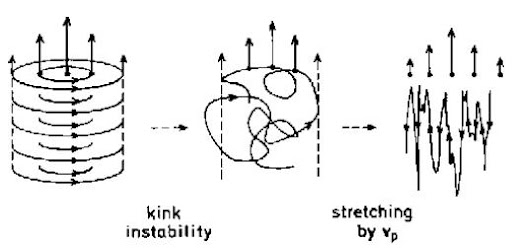
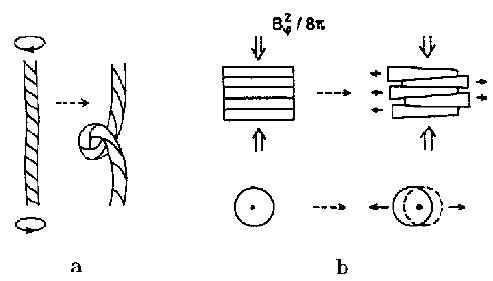 Figure 13: Production of a longitudinal field by kink instability. The longitudinal
flow is taken to depend on distance from the jet axis. Initially parallel to
magnetic surfaces, instability forces the flow to cross the displaced field lines.
The differential flow speed stretches the displaced azimuthal field lines along
the axis.
From astro-ph/9602022:
9 Kink instability
In the previous section we found that a predominantly toroidal field develops
outside the Alfv´en surface. In high mass loss flows, it develops also inside the
Alfv´en radius. Consider first the case of a low-μ flow, outside the Alfv´en surface.
Assume that the flow is well collimated, and move into a frame comoving with
the flow. In this frame, we see a toroidal field, slowly decreasing in time by
the expansion of the flow. A predominantly toroidal field, however, is violently
unstable to kink instabilities: such a configuration is equivalent to the linear
pinch (e.g. Roberts 1967, Parker 1979, Bateman 1980). The mechanism of the
instability is illustrated in figure 12. An initially axial, untwisted, magnetic field
is wound up and becomes unstable when the azimuthal becomes larger than the
axial field strength. This is akin to the instability of a twisted rubber band
(figure 12a). Instability sets in when the axial tension vanishes. Denoting by
Bz and Bφ the axial and azimuthal components of the field, the axial component
of the stress is (−B^2_z +B^2_φ)/8π. The first term is the net magnetic tension due to
the axial field, and is stabilizing; it likes to keep field lines straight. The second
term, equal to the magnetic pressure exerted by the azimuthal component, is
positive, expansive. When the pressure becomes larger than the tension, some
of the energy put in by the twisting is released by a kink. Each kink reduces
the number of windings by one, at the expense of increasing the energy in the
axial field by lengthening axial field lines somewhat6.
(6The condition B > Bz can underestimate the degree of instability. A cylindrical field
configuration typically becomes unstable already when it is twisted by more than one full
turn, independent of the distance between the surfaces at which the twist is applied (Kruskal-
Shafranov condition). In our case, this is not relevant, however, because B /Bp increases
with distance in such a way that the number of turns in the field is always less than one at
the point where B first exceeds Bp.)
The kink instability is a transition to a nearby equilibrium of lower energy,
i.e. the instability saturates at a finite amplitude. This is because the amount of
azimuthal field energy that can be released is finite, while the energy expended
lengthening the the axial field increases indefinitely with the amplitude of the
perturbation. In a predominantly azimuthal field, the instability can also be
visualized as shown in figure 12b. A stack of deformable disks (think of the
disks in your spinal column, for example) is compressed (by the pressure of the
instability has ample time to act as the jet moves outward. The effect of the
instability would be less dramatic close to the Alfv´en radius. Choudhuri and
K¨onigl (1986) have proposed that kink instability near the Alfv´en radius may
be responsible for some of the alignment anomalies seen in jets at the VLBI
scale.
It takes longer than the instability time scale to dissipate the disorganized
field component it produces (this is related to the known slow dissipation of
magnetic helicity, and is seen also in numerical simulations, e.g. Galsgaard 1995).
This dissipation, however, eventually leads to a reduction of the field strength
compared with the standard axisymmetric jet. A second consequence of kink
instability is therefore that the ratio of magnetic to kinetic energy flux in the
jet becomes less than unity (see section 5.5). Since the Alfv´en speed is lower,
the fast mode critical point is closer to the source, perhaps at only a few Alfv´en
radii. Most of the observed jet would then be outside the fast mode point,
and kinetic energy dominated. In short: the jet behaves like a ballistic flow,
like a water jet from a fire hose. This would simplify the magnetic jet picture
considerably: though the acceleration process is intensely magnetic, it would
eventually produce a ballistically moving jet in which magnetic stresses are a
secondary factor as far as the dynamics is concerned.
Some observational evidence for the action of kink instabilities may be the
fact that the magnetic field tends to be parallel to jet axis, at least in the
faster (type II) jets (Bridle and Perley, 1984). If the flow speed along the
jet is not exactly uniform over its cross section, the irregularities in the field
produced by the instability will be stretched along the jet axis, see figure 13.
The strength of this longitudinal field will be comparable to the kinetic energy
of differential velocity across the jet. This field will have many small scale
reversals of direction, explaining why the total poloidal magnetic flux inferred
from observations (which are not sensitive to the direction of the field lines) is
much larger than can be easily accomodated in the accelerating region. These
observational indications can equally be explained by stretching of the field
by interaction with an external medium, but irregularities produced internally
by kinking have the advantage that they will also work in the absence of any
interaction with the surroundings.
From Spruit et al. MNRAS, 1997, 288, 333:


No comments:
Post a Comment