- astro-ph/0610372 [abs, ps, pdf, other] :
- Title: Gamma ray signatures of ultra high energy cosmic ray accelerators: electromagnetic cascade versus synchrotron radiation of secondary electrons
Authors: Stefano Gabici, Felix A. Aharonian (MPIK, Heidelberg)
Comments: To appear in Astrophysics and Space Science, proceeding of "The multi messenger approach to high energy gamma ray sources", Barcelona, June 2006We discuss the possibility of observing ultra high energy cosmic ray sources inhigh energy gamma rays. Protons propagating away from their accelerators produce secondary electrons during interactions with cosmic microwave background photons. These electrons start an electromagnetic cascade that results in a broad band gamma ray emission. We show that in a magnetized Universe ($B \gtrsim 10^{-12}$ G) such emission is likely to be too extended to be detected above the diffusebackground. A more promising possibility comes from the detection of synchrotron photons from the extremely energetic secondary electrons. Although this emission is produced in a rather extended region of size $\sim 10Mpc$, it is expected to be point-like and detectable at GeV energies if the intergalactic magnetic field is at the nanogauss level.
Friday, October 13, 2006
Gamma ray signatures of ultra high energy cosmic ray accelerators: electromagnetic cascade versus synchrotron radiation of secondary electrons

Physical Properties of Wolf-Rayet Stars
- astro-ph/0610356 [abs, ps, pdf, other] :
- Title: Physical Properties of Wolf-Rayet Stars
Authors: Paul A Crowther
Comments: 75 pages, 8 figures. Manuscript submitted to "Annual Review of Astronomy & Astrophysics", for publication in Volume 45 (2007). Version with full resolution figures is available from this ftp URLThe striking broad emission line spectroscopic appearance of Wolf-Rayet stars have long defied analysis due to the extreme physical conditions of their line and continuum forming regions. Recently, model atmosphere studies have advanced sufficiently to enable the determination of stellar temperatures, luminosities, elemental abundances, ionizing fluxes and wind properties. The observed distribution of nitrogen (WN) and carbon (WC) sequence WR stars in the Milky Way and nearby star forming galaxies is discussed, from which lower limits to progenitor masses are 25, 40, 75 Msun for hydrogen-depleted (He-burning) WN, WC, and H-rich (H-burning) WN stars, respectively. WR stars in massive binaries permit studies of wind-wind interactions and dust formation in WC systems, plus current mass determinations, revealing typically 10-25 Msun, although extending up to 80Msun for H-rich WN stars. Theoretical and observational evidence in favour of a metallicity dependence of WR winds is presented, with implications for evolutionary models, ionizing fluxes, and the role of WR stars within the context of core-collapse supernovae and long-duration gamma ray bursts.
Physical problems (microphysics) in relativistic plasma flows
- astro-ph/0610345 [abs, ps, pdf, other] :
- Title: Physical problems (microphysics) in relativistic plasma flows
Authors: L. O. Silva
Comments: 19 pages, 18 figuresMany problems in astrophysics involve relativistic outflows. The plasma dynamics in these scenarios is critical to determine the conditions for the self-consistent evolution of the fields and particle acceleration. Advances in computer power now allow for kinetic plasma simulations, based on the particle-in-cell (PIC) paradigm, capable of providing information about the role of plasma instabilities in relativistic outflows. A discussion of the key issues associated with PIC simulations is presented, along with some the most important results and open questions, with a particular emphasis on the long time evolution of the filamentation, or Weibel, instability, and on the possible collisionless mechanisms for particle acceleration arising in the collision of relativistic plasma shells.
Tuesday, October 10, 2006
公式编辑器MathType使用技巧
MathType是“公式编辑器”的功能强大而全面的版本。如果要经常在文档中编排各种复杂的数学、化学公式,则MathType是非常合适的选择。MathType用法与“公式编辑器”一样简单易学,而且其额外的功能使你的工作更快捷,文档更美观。
MathType包括:
(1)Euclid字体设置了几百个数学符号。
(2)具有应用于几何、化学及其他方面的新样板和符号。
(3)专业的颜色支持。
(4)为全球广域网创建公式。
(5)将输出公式译成其他语言(例如:TeX、AMS-TeX、LaTeX、MathML及自定义语言)的翻译器。
(6)用于公式编号、格式设置及转换Microsoft Word文档的专用命令。
(7)可自定义的工具栏,可容纳最近使用过的几百个符号、表达式和公式。
(8)可自定义的键盘快捷键。

MathType公式编辑器
在编辑word文档时,如果需要录入公式将是一件非常痛苦的事情。利用Mathtype作为辅助工具,会为文档的公式编辑和修改提供很多方便。下面介绍几种mathtype中比较重要的技巧
一、批量修改公式的字号和大小
论文中,由于排版要求往往需要修改公式的大小,一个一个修改不仅费时费力还容易使word产生非法操作。
解决办法,批量修改:双击一个公式,打开mathtype,进入编辑状态,
点击size菜单->define->字号对应的pt值,一般五号对应10pt,小四对应12pt
其他可以自己按照具体要求自行调节。其他默认大小设置不推荐改动。
然后点击preference->equation preference -> save to file ->存一个与默认配置文件不同的名字,然后关闭mathtype回到word文档。
点击word界面上的mathtype ->format equation -> load equation preferrence选项下面的browse按钮,选中刚才存的配置文件,点选whole document选项,确定,就安心等着公式一个个改过来。
二、公式的自动编号和引用功能
mathtype提供四种类型的公式输入:inline(文本中的公式),display style没有编号的单行公式,left numbered display style编号在左边,right numbered display style编号在右边。
在编辑公式时,如果出现删除公式的情况,采用手动编号会使得修改量变得很大,采用自 动编号和自动引用会方便很多,这些功能都已经在安装mathtype后集成在word的按钮上了,将鼠标悬停在相应的按钮上就可以看到具体的功能描述,由 于应用十分简单,就不再此赘述了。
三、与latex代码之间的转换
mathtype编辑器中的translator里面提供了向latex, amslatex等格式的方便转换。选择相应的翻译目标后,将下面的两个inculde选项去掉,你的mathtype就可以直接将公式翻译称为 latex代码了,这对于latex的初学者和记不住latex代码的人非常重要。
四、在公式中使用特殊符号
MathType更多地为用户考虑到了使用上的方便,如一些特殊且经常在数学公式中用到的符号几乎都收录到了工具条上,只需轻轻一点,此符号便可在公式中轻松插入。
觉得符号还是太少了?别着急,点击“编辑”/“插入符号”,看看这里的符号够不够用?你也可以通过变换字体把汉字插入进来。
为了输入的方便,你甚至可以为这些符号分别制订一个快捷键(如图2)——点击符号 后,在“输入一个下标快捷键”按下你希望用的快捷键(对于同一个符号甚至可以定义几个快捷键),再单击“assign(指定)”按钮,此快捷键将出现于 “当前键”下。以后在MathType窗口中,可以直接用快捷键来输入对应的符号。
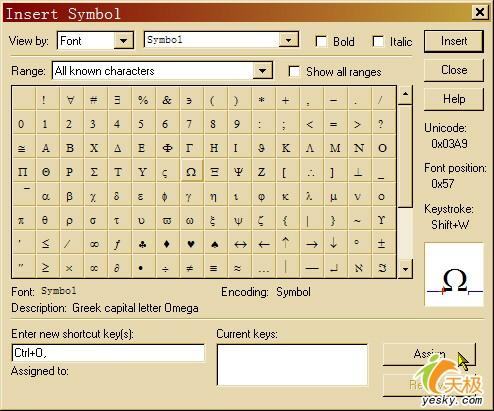
在MathType窗口中,可以直接用快捷键来输入对应的符号。
五、直接套用现成公式
MathType方便的还不止于此,像在数学中经常用到的公式也能通过直接点击便实现输入。例如,以往在“公式编辑器”中要输入一元二次方程的求根公式,得从多种模板中选择,还要自己输入那些字母、符号;而现在,你只需单击现成的按钮一次,这个公式便跃然纸上了!。
六、更改公式文字的字体、颜色
如果说在“公式编辑器”更改文字字体不算麻烦的话,那么修改文字颜色就很难实现了。但在MathType中,一切变得极为简单。
小提示:在Powerpoint中更改公式文字的颜色可用以下方法:插入公式后,选 中它,从有间菜单中选择“设置对象格式”,然后切换到对话框的“图片”选项卡下,点击“重新着色”按钮打开“图片重新着色”对话框,之后就可以把原来的颜 色更换为新的颜色。(在Word中不可以更改公式文字颜色。)
点击“样式”菜单下的“定义”项,在弹出的对话框中你可以设置默认用的字体效果:点选“高级”按钮后显示更多项目的字体设置(如图3),你可以为不同的文字、符号等设置不同的默认字体和风格。

可以为不同的文字、符号等设置不同的默认字体和风格。
要更改公式文字的颜色更简单,只需点击“格式”/“颜色”项便可找到。
小提示:如果已经输入了某个公式请先选中它,否则所作的设置将只对后续输入的公式起作用。
如果要更改公式中各级符号的默认大小,则打开“尺寸”/“定义”菜单项,在打开的“定义尺寸”对话框中进行设置(如图4)。

更改公式中各级符号的默认大小
七、保存公式:
如果是在Word中调用MathType来输入公式的,那一定希望能直接将公式插入 到Word文档中。当你编辑好公式之后,点击“文件”/“更新 XXX”(XXX为当前编辑的Word文档名)即可。退出MathType后,你可以像调整绘制的图形一样调整公式的大小、位置、环绕方式等。
小提示:执行更新操作后,你会在Word文档中发现公式带有斜线背景。其实,如果你不想再在MathType中编辑公式了,就应该点击“文件”/“退出”,这样,那些斜线条会自动消失的。
此外,MathType还允许你将公式输出为WMF、GIF等图像格式,方便在其他程序中插入或者做进一步的修改。最后需要说明的是,这个软件的评估版本在 30天评估期内功能是完全的,评估期过后将运行在Lite方式,但是它依然能完成常规的公式编辑工作。
八、添加常用公式
MathType的一大特色就是可以自己添加或删除一些常用公式,添加的办法是:先输入我们要添加的公式,然后选中该公式,用鼠标左键拖到工具栏中适当位置即可。删除的方式是右击工具图标,选择“删除”命令即可。
九、让“公式编辑器”与MathType共存
Word中的“公式编辑器”功能可以满足我们大多数公式和简单符号的编辑,对于复杂的公式和符号Word中的“公式编辑器”就显得无能为力了,比如一个典型的例子:不能在字母上方输入圆弧符号,这就满足不了中学阶段有关圆的一些数学问题,也有很多化学方程式无法完成。
于是很多老师都改用了“公式编辑器”的升级版本MathType(“公式编辑器”实 际是Design Science公司授权给微软的MathType的简化版本)。但MathType对汉字的支持非常不好,如果我们经常需要在公式中使用汉字(如物理和化 学中经常使用汉字下标)就不方便了,在编辑公式时有时不能输入汉字,有时能输入汉字,但往往输入汉字时在MathType编辑界面显示乱码,如图5:

输入汉字时在MathType编辑界面显示乱码
返回到Word界面时虽然变成了汉字,位置往往很乱。MathType中有对远东文 字的支持,但实际根本没法使用。尽管在公式中使用汉字的机会并不多,我们还可以想办法把汉字回避掉,但总是不方便。Word中的“公式编辑器”可以满足我 们对汉字支持的要求,但它的功能和MathType相比差得太远了。
有没有办法让“公式编辑器”与MathType共存?把MathType所在的安装 文件完整地复制一次到另一个目录或磁盘中,然后在系统中卸载MathType。这时在Word的菜单中执行“插入→对象→对象类型”,在“对象类型”中选 “Microsoft 公式3.0”就启动Word自带的“公式编辑器”,在“对象类型”中选“MathType 5.0 Equation”就启动MathType。这样就可以根据需要启用不同的工具了。
提示:在系统中卸载MathType后,必须在新复制的文件夹中运行一次MathType,不然在执行“插入→对象→对象类型”时,在“对象类型”中找不到MathType 5.0 Equation。
根据我的实际操作和试验,得出的结论是MathType安装时在系统中写入了一些信 息,Word在启动时也启动MathType中的模板MathType's Commands for Microsoft Word.dot。这个模板把执行“公式编辑器”的命令指向MathType。从系统中卸载MathType,这种指向就不存在了,“公式编辑器”和 MathType就可以“和平共处”了。注意:单把模板MathType's Commands for Microsoft Word.dot删除是不行的。
The GRB early optical flashes from internal shocks: application to GRB990123, GRB041219a and GRB060111b
Comments: 11 pages, minor revision, accepted by MNRAS
With the successful launch of the Swift Gamma-Ray Burst Explorer, people expected the prompt optical flash like GRB990123 would be easily detected. However the fact that early optical flash have not been detected for a number of GRBs indicates the reverse shock must be suppressed. Here we explore the possibility that the optical flash may arise from the internal shock. We find that, under certain circumstance, the optical flash of GRB990123 and GRB060111b can really be explained by the internal shock. For GRB041219a, the prompt optical emission was correlated with the gamma-ray emission, we explain this feature also in the internal shock scenario, the optical emission is the low energy extension of the gamma-ray emission, and we can restrict its redshift $z\sim 0.2$. As for GRB050904, we have shown in previous paper that the optical flash was produced by synchrotron radiation and the X-ray flare was produced by the synchrotron-self-Compton mechanism. Therefore we conclude that the early optical flash of GRBs can usually come from the internal shock. Meanwhile since the condition to produce the optical flash is not easily satisfied, so the optical flash like GRB990123 should not be common in GRBs. In addition, we also discussed the synchrotron-self-Compton effect in the internal shock model, and find that for different values of parameters, there would be soft gamma-ray (100 KeV), hard gamma-ray (10 MeV) and GeV flare accompanying the optical flash. For GRB like GRB990123, a GeV flare with fluence about 10^{-8} erg cm^{-2} s^{-1} is expected, which may be detected by the GLAST satellite.
Full-text: PostScript, PDF, or Other formats
Gamma Ray Bursts as standard candles to constrain the cosmological parameters
- astro-ph/0610248 [abs, ps, pdf, other] :
- Title: Gamma Ray Bursts as standard candles to constrain the cosmological parameters
Authors: G. Ghirlanda (1), G. Ghisellini (1), C. Firmani (1,2) ((1) INAF - Osservatorio Astronomico di Brera; (2) Instituto de Astronomia, U.N.A.M., Mexico)
Comments: 39 pages, 23 figures, 2 tables. Accepted for publication in the New Journal of Physics focus issue, "Focus on Gamma--Ray bursts in the Swift Era" (Eds. D. H. Hartmann, C. D. Dermer, J. Greiner)
Journal-ref: New Journal of Physics, 8 (2006) 123Gamma Ray Bursts (GRBs) are among the most powerful sources in the Universe: they emit up to 10^54 erg in the hard X-ray band in few tens of seconds. The cosmological origin of GRBs has been confirmed by several spectroscopic measurements of their redshifts, distributed in the range 0.1-6.3. These two properties make GRBs very appealing to investigate the far Universe. The energetics implied by the observed fluences and redshifts span at least four orders of magnitudes. Therefore, at first sight, GRBs are all but standard candles. But there are correlations among some observed quantities which allow us to know the total energy or the peak luminosity emitted by a specific burst with a great accuracy. Through these correlations, GRBs become "known" candles to constrain the cosmological parameters. One of these correlation is between the rest frame peak spectral energy E_peak and the total energy emitted in gamma--rays E_gamma, properly corrected for the collimation factor. Another correlation, discovered very recently, relates the total GRB luminosity L_iso, its peak spectral energy E_peak and a characteristic timescale T_0.45, related to the variability of the prompt emission. It is based only on prompt emission properties, it is completely phenomenological, model independent and assumption--free. The constraints found through these correlations on the Omega_M and Omega_Lambda parameters are consistent with the concordance model. The present limited sample of bursts and the lack of low redshift events, necessary to calibrate these correlations, makes the cosmological constraints obtained with GRBs still large compared to those obtained with other cosmological probes (e.g. SNIa or CMB). However, the newly born field of GRB--cosmology is very promising for the future.
- 译文:
- 下一步的兴趣,可能交给张磊完成
General Relativity effects and line emission
- astro-ph/0610224 [abs, ps, pdf, other] :
- Title: General Relativity effects and line emission
Authors: Giorgio Matt
Comments: to appear in Astronomische Nachrichten, Proceedings of the ESAC Workshop "Variable and broad lines around black holes"General Relativity effects (gravitational redshift, light bending, ...) strongly modify the characteristics of the lines emitted close to the Black Hole in Active Galactic Nuclei and Galactic Black Hole systems. These effects are reviewed and illustrated, with particular emphasis on line emission from the accretion disc. Methods, based on the iron line, to measure the two astrophysically relevant parameters of a Black Hole, the mass and spin, are briefly discussed.
- 译文:
- 广义相对论效应
Saturday, October 07, 2006
Full Text Searching in the Astrophysics Data System
Comments: To appear in Library and Information Systems in Astronomy V
Subj-class: Digital Libraries; Databases
The Smithsonian/NASA Astrophysics Data System (ADS) provides a search system for the astronomy and physics scholarly literature. All major and many smaller astronomy journals that were published on paper have been scanned back to volume 1 and are available through the ADS free of charge. All scanned pages have been converted to text and can be searched through the ADS Full Text Search System. In addition, searches can be fanned out to several external search systems to include the literature published in electronic form. Results from the different search systems are combined into one results list.
The ADS Full Text Search System is available at: this http URL