Tuesday, December 12, 2006

The role of kink instability in Poynting-flux dominated jets

Authors: Dimitrios Giannios, Henk C. Spruit (Max Planck Institute for Astrophysics)
Comments: 13 pages, 7 figures, accepted for publication in A&A, typos Corrected
The role of kink instability in magnetically driven jets is explored through numerical one-dimensional steady relativistic MHD calculations. The instability is shown to have enough time to grow and influence the dynamics of Poynting-flux dominated jets. In the case of AGN jets, the flow becomes kinetic flux dominated at distances larger than ~1000 r_g because of the rapid dissipation of Poynting flux. When applied to GRB outflows, the model predicts more gradual Poynting dissipation and moderately magnetized flow at distances of ~10^{16} cm where the deceleration of the ejecta due to its interaction with the external medium is expected. The energy released by the instability can power the compact ``blazar zone'' emission and the prompt emission of GRB outflows with high radiative efficiencies.

Full-text: PostScript, PDF, or Other formats

Spectral and timing properties of a dissipative GRB photosphere

Authors: Dimitrios Giannios, Henk C. Spruit (Max Planck Institute for Astrophysics)
Comments: 10 pages, 6 figures, A&A, submitted
We explore the observational appearance of the photosphere of an ultrarelativistic flow with internal dissipation of energy as predicted by the magnetic reconnection model. Previous study of the radiative transfer in the photospheric region has shown that gradual dissipation of energy results in a hot photosphere. There, inverse Compton scattering of the thermal radiation advected with the flow leads to powerful photospheric emission with spectral properties close to those of the observed prompt GRB emission. Here, we build on that study by calculating the spectra for a large range of the characteristics of the flow. An accurate fitting formula is given that provides the photospheric spectral energy distribution in the ~10 keV to ~10 MeV energy range (in the central engine frame) as a function of the basic physical parameters of the flow. It facilitates the direct comparison of the model predictions with observations, including the variability properties of the lightcurves. We verify that the model naturally accounts for the observed clustering in peak energies of the E*f(E) spectrum. In this model, the Amati relation indicates a tendency for the most luminous bursts to have more energy per baryon. If this tendency also holds for individual GRB pulses, the model predicts the observed narrowing of the width of pulses with increasing photon energy.

Full-text: PostScript, PDF, or Other formats

Fermion Production in Strong Magnetic Fields through Anomalous Magnetic Moment

Authors: Hyun Kyu Lee, Yongsung Yoon
Comments: 7 pages with 1 figure
We calculate the explicit form of the real and imaginary parts of the effective potential for a uniform magnetic field which interacts with fermions with anomalous magnetic moments through the Pauli interaction. It is found that the non-vanishing imaginary part develops for a magnetic field stronger than a critical field, which is the ratio of the fermion mass to its anomalous magnetic moment. This implies the instability of the uniform magnetic field to produce fermion pairs with the production rate density $w(x) = \frac{m^{4}}{24\pi} (\frac{|\mu_a |}{m}-1)^3 (\frac{|\mu_a B|}{m}+3)$.

Full-text: PostScript, PDF, or Other formats

The Gamma Ray Burst Luminosity Function in the Light of the Swift 2-year Data

astro-ph/0612278 [abs, ps, pdf, other] :
Title: The Gamma Ray Burst Luminosity Function in the Light of the Swift 2-year Data
Authors: R. Salvaterra, C. Chincarini
Comments: 9 pages, 3 figures, submitted to ApJ Letter

We compute the luminosity function (LF) and the formation rate of long gamma ray bursts (GRBs) by fitting the observed differential peak flux distribution obtained by the BATSE satellite in three different scenarios: i) GRBs follow the cosmic star formation and their LF is constant in time; ii) GRBs follow the cosmic star formation but the LF varies with redshift; iii) GRBs form preferentially in low-metallicity environments. We find that the differential peak flux number counts obtained by BATSE and by Swift can be reproduced using the same LF and GRB formation rate, indicating that the two satellites are observing the same GRB population. We then check the resulting redshift distributions in the light of Swift 2-year data, focusing in particular on the relatively large sample of GRBs detected at z>2.5. We show that models in which GRBs trace the cosmic star formation and are described by a constant LF are ruled out by the number of high-z Swift detections. This conclusion does not depend on the redshift distribution of bursts that lack of optical identification, nor on the existence of a decline in star formation rate at z>2, nor on the adopted faint-end of the GRB LF. Swift observations can be explained by assuming that the LF varies with time and/or that GRB formation is limited to low-metallicity environments.

Spectral Evolution of GRB Tails: Central Engine and Internal Shock Afterglows?

astro-ph/0612246 [abs, ps, pdf, other] :
Title: Spectral Evolution of GRB Tails: Central Engine and Internal Shock Afterglows?
Authors: Bin-Bin Zhang, En-Wei Liang, Bing Zhang
Comments: 11 pages,2 figures

A steep decay segment tens to hundreds of seconds after the gamma-ray burst (GRB) prompt emission is commonly observed in the {\em Swift} XRT light curves, which is regarded as the tail emission of the prompt gamma-rays. The most straightforward interpretation is the curvature effect due to delay of propagation of photons from larger angles with respect to the line of sight. Prompted by the observed strong spectral evolution in the tails of GRB 060218 and GRB 060614, we present a systematic time-resolved spectral analysis of 17 bright GRB tails observed by XRT. While 7 tails in our sample have no spectral evolution and can be explained with the curvature effect, the other 10 tails all show significant hard-to-soft spectral evolution. A toy model that combines the curvature effect with an underlying putative central engine afterglow component can roughly explain the observed light curves and spectral evolutions for 7 of them. The suggested central engine afterglow is typically soft ($\beta=2.5\sim 6.4$) and decays as normal GRB afterglows (typically $\alpha=0.8\sim 1.5$), similar to the late afterglow of GRB 060218. There are 3 cases (GRB 050724, GRB 060218, and GRB 060614) that cannot be described by this model. We suggest that these tails may be interpreted as an internal shock afterglow due to cooling of the shock-heated region. More detailed physical models are called for to understand these two possibly new types of afterglows.

Simulations of the Disk-Jet Interaction in GRS 1915+105 and Other Systems

astro-ph/0612236 [abs, ps, pdf, other] :
Title: Simulations of the Disk-Jet Interaction in GRS 1915+105 and Other Systems
Authors: David M. Rothstein (Cornell University)
Comments: 10 pages, 6 figures; accepted for publication in the proceedings of VI Microquasar Workshop: Microquasars and Beyond, Sept 18-22 2006, Como, Italy, ed: T. Belloni (2006), PoS(MQW6)037

After an X-ray binary experiences a transient jet ejection, it undergoes a phase in which its X-ray light curve is dominated, for some time, by thermal emission from an accretion disk surrounding the black hole. The accretion physics in the thermal-dominant state is understood better than in any other, and it is therefore the best state for comparing observations to theoretical models. Here, I present simulations that study the way a thermally-emitting disk might be expected to behave immediately after a large-scale, steady jet has been removed from the system in the form of a sudden ejection. I simulate the ejection's effect on the disk by allowing the strength of turbulence (modeled by the alpha parameter of Shakura and Sunyaev) to increase rapidly in time, and I show how this change can lead to an outburst in an otherwise-steady disk. The motivation for treating the jet removal in this way is the fact that many models for jets involve large-scale magnetic fields that should inhibit the magnetorotational instability believed to drive turbulence; this should naturally lead to a rapid increase in turbulence when the magnetic field is ejected from the system or otherwise destroyed during the ejection event. I show how the timescale and luminosity of the outburst can be controlled by the manner in which alpha is allowed to change, and I briefly discuss ways in which these simulations can be compared to observations of X-ray binaries, in particular GRS 1915+105, which shows the most complex and variable behavior of any black hole system in outburst.

Making a Short Gamma-Ray Burst from a Long one: Implications for the Nature of GRB 060614

astro-ph/0612238 [abs, ps, pdf, other] :
Title: Making a Short Gamma-Ray Burst from a Long one: Implications for the Nature of GRB 060614
Authors: Bing Zhang, Bin-Bin Zhang, En-Wei Liang, Neil Gehrels, David N. Burrows, Peter Meszaros
Comments: 7 pages, 3 figures, to appear in ApJ Letters

The absence of a supernova accompanying the nearby long GRB 060614 poses a great puzzle about the progenitor of this event and challenges the current GRB classification scheme. This burst displays a short-hard emission episode followed by extended soft emission with strong spectral evolution. Noticing that this burst has an isotropic gamma-ray energy only ~8 times that of GRB 050724, a good candidate of merger-type short GRBs, we generate a ``pseudo'' burst that is ~8 times less energetic than GRB 060614 based on the spectral properties of GRB 060614 and the Ep ~ Eiso^{1/2} (Amati) relation. We find that this pseudo-burst would have been detected by BATSE as a marginal short-duration GRB, and would have properties in the Swift BAT and XRT bands similar to GRB 050724. This suggests that GRB 060614 is likely a more intense event in the traditional short-hard GRB category as would be detected by BATSE. Events like GRB 060614 that seem to defy the traditional short vs. long classification of GRBs may require modification of our classification terminology for GRBs. By analogy with supernova classifications, we suggest that GRBs be classified into Type I (typically short and associated with old populations) and Type II (typically long and associated with young populations). We propose that GRB 060614 belongs to Type I, and predict that similar events will be detected in elliptical galaxies.

Friday, October 13, 2006

Gamma ray signatures of ultra high energy cosmic ray accelerators: electromagnetic cascade versus synchrotron radiation of secondary electrons

astro-ph/0610372 [abs, ps, pdf, other] :
Title: Gamma ray signatures of ultra high energy cosmic ray accelerators: electromagnetic cascade versus synchrotron radiation of secondary electrons
Authors: Stefano Gabici, Felix A. Aharonian (MPIK, Heidelberg)
Comments: To appear in Astrophysics and Space Science, proceeding of "The multi messenger approach to high energy gamma ray sources", Barcelona, June 2006

We discuss the possibility of observing ultra high energy cosmic ray sources inhigh energy gamma rays. Protons propagating away from their accelerators produce secondary electrons during interactions with cosmic microwave background photons. These electrons start an electromagnetic cascade that results in a broad band gamma ray emission. We show that in a magnetized Universe ($B \gtrsim 10^{-12}$ G) such emission is likely to be too extended to be detected above the diffusebackground. A more promising possibility comes from the detection of synchrotron photons from the extremely energetic secondary electrons. Although this emission is produced in a rather extended region of size $\sim 10Mpc$, it is expected to be point-like and detectable at GeV energies if the intergalactic magnetic field is at the nanogauss level.

Physical Properties of Wolf-Rayet Stars

astro-ph/0610356 [abs, ps, pdf, other] :
Title: Physical Properties of Wolf-Rayet Stars
Authors: Paul A Crowther
Comments: 75 pages, 8 figures. Manuscript submitted to "Annual Review of Astronomy & Astrophysics", for publication in Volume 45 (2007). Version with full resolution figures is available from this ftp URL

The striking broad emission line spectroscopic appearance of Wolf-Rayet stars have long defied analysis due to the extreme physical conditions of their line and continuum forming regions. Recently, model atmosphere studies have advanced sufficiently to enable the determination of stellar temperatures, luminosities, elemental abundances, ionizing fluxes and wind properties. The observed distribution of nitrogen (WN) and carbon (WC) sequence WR stars in the Milky Way and nearby star forming galaxies is discussed, from which lower limits to progenitor masses are 25, 40, 75 Msun for hydrogen-depleted (He-burning) WN, WC, and H-rich (H-burning) WN stars, respectively. WR stars in massive binaries permit studies of wind-wind interactions and dust formation in WC systems, plus current mass determinations, revealing typically 10-25 Msun, although extending up to 80Msun for H-rich WN stars. Theoretical and observational evidence in favour of a metallicity dependence of WR winds is presented, with implications for evolutionary models, ionizing fluxes, and the role of WR stars within the context of core-collapse supernovae and long-duration gamma ray bursts.

Physical problems (microphysics) in relativistic plasma flows

astro-ph/0610345 [abs, ps, pdf, other] :
Title: Physical problems (microphysics) in relativistic plasma flows
Authors: L. O. Silva
Comments: 19 pages, 18 figures

Many problems in astrophysics involve relativistic outflows. The plasma dynamics in these scenarios is critical to determine the conditions for the self-consistent evolution of the fields and particle acceleration. Advances in computer power now allow for kinetic plasma simulations, based on the particle-in-cell (PIC) paradigm, capable of providing information about the role of plasma instabilities in relativistic outflows. A discussion of the key issues associated with PIC simulations is presented, along with some the most important results and open questions, with a particular emphasis on the long time evolution of the filamentation, or Weibel, instability, and on the possible collisionless mechanisms for particle acceleration arising in the collision of relativistic plasma shells.

Tuesday, October 10, 2006

公式编辑器MathType使用技巧

MathType是“公式编辑器”的功能强大而全面的版本。如果要经常在文档中编排各种复杂的数学、化学公式,则MathType是非常合适的选择。MathType用法与“公式编辑器”一样简单易学,而且其额外的功能使你的工作更快捷,文档更美观。

  MathType包括:

  (1)Euclid字体设置了几百个数学符号。

  (2)具有应用于几何、化学及其他方面的新样板和符号。

  (3)专业的颜色支持。

  (4)为全球广域网创建公式。

  (5)将输出公式译成其他语言(例如:TeX、AMS-TeX、LaTeX、MathML及自定义语言)的翻译器。

  (6)用于公式编号、格式设置及转换Microsoft Word文档的专用命令。

  (7)可自定义的工具栏,可容纳最近使用过的几百个符号、表达式和公式。

  (8)可自定义的键盘快捷键。

超强公式编辑器MathType使用技巧

MathType公式编辑器

  在编辑word文档时,如果需要录入公式将是一件非常痛苦的事情。利用Mathtype作为辅助工具,会为文档的公式编辑和修改提供很多方便。下面介绍几种mathtype中比较重要的技巧

  一、批量修改公式的字号和大小

  论文中,由于排版要求往往需要修改公式的大小,一个一个修改不仅费时费力还容易使word产生非法操作。

  解决办法,批量修改:双击一个公式,打开mathtype,进入编辑状态,

  点击size菜单->define->字号对应的pt值,一般五号对应10pt,小四对应12pt

  其他可以自己按照具体要求自行调节。其他默认大小设置不推荐改动。

  然后点击preference->equation preference -> save to file ->存一个与默认配置文件不同的名字,然后关闭mathtype回到word文档。

   点击word界面上的mathtype ->format equation -> load equation preferrence选项下面的browse按钮,选中刚才存的配置文件,点选whole document选项,确定,就安心等着公式一个个改过来。

 二、公式的自动编号和引用功能

  mathtype提供四种类型的公式输入:inline(文本中的公式),display style没有编号的单行公式,left numbered display style编号在左边,right numbered display style编号在右边。

   在编辑公式时,如果出现删除公式的情况,采用手动编号会使得修改量变得很大,采用自 动编号和自动引用会方便很多,这些功能都已经在安装mathtype后集成在word的按钮上了,将鼠标悬停在相应的按钮上就可以看到具体的功能描述,由 于应用十分简单,就不再此赘述了。

  三、与latex代码之间的转换

   mathtype编辑器中的translator里面提供了向latex, amslatex等格式的方便转换。选择相应的翻译目标后,将下面的两个inculde选项去掉,你的mathtype就可以直接将公式翻译称为 latex代码了,这对于latex的初学者和记不住latex代码的人非常重要。

  四、在公式中使用特殊符号

  MathType更多地为用户考虑到了使用上的方便,如一些特殊且经常在数学公式中用到的符号几乎都收录到了工具条上,只需轻轻一点,此符号便可在公式中轻松插入。

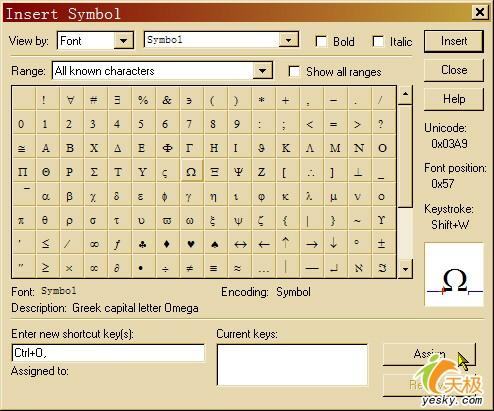
  觉得符号还是太少了?别着急,点击“编辑”/“插入符号”,看看这里的符号够不够用?你也可以通过变换字体把汉字插入进来。

   为了输入的方便,你甚至可以为这些符号分别制订一个快捷键(如图2)——点击符号 后,在“输入一个下标快捷键”按下你希望用的快捷键(对于同一个符号甚至可以定义几个快捷键),再单击“assign(指定)”按钮,此快捷键将出现于 “当前键”下。以后在MathType窗口中,可以直接用快捷键来输入对应的符号。

超强公式编辑器MathType使用技巧(2)

在MathType窗口中,可以直接用快捷键来输入对应的符号。

  五、直接套用现成公式

  MathType方便的还不止于此,像在数学中经常用到的公式也能通过直接点击便实现输入。例如,以往在“公式编辑器”中要输入一元二次方程的求根公式,得从多种模板中选择,还要自己输入那些字母、符号;而现在,你只需单击现成的按钮一次,这个公式便跃然纸上了!。

  六、更改公式文字的字体、颜色

  如果说在“公式编辑器”更改文字字体不算麻烦的话,那么修改文字颜色就很难实现了。但在MathType中,一切变得极为简单。

   小提示:在Powerpoint中更改公式文字的颜色可用以下方法:插入公式后,选 中它,从有间菜单中选择“设置对象格式”,然后切换到对话框的“图片”选项卡下,点击“重新着色”按钮打开“图片重新着色”对话框,之后就可以把原来的颜 色更换为新的颜色。(在Word中不可以更改公式文字颜色。)

  点击“样式”菜单下的“定义”项,在弹出的对话框中你可以设置默认用的字体效果:点选“高级”按钮后显示更多项目的字体设置(如图3),你可以为不同的文字、符号等设置不同的默认字体和风格。

超强公式编辑器MathType使用技巧(2)

可以为不同的文字、符号等设置不同的默认字体和风格。

  要更改公式文字的颜色更简单,只需点击“格式”/“颜色”项便可找到。

  小提示:如果已经输入了某个公式请先选中它,否则所作的设置将只对后续输入的公式起作用。

  如果要更改公式中各级符号的默认大小,则打开“尺寸”/“定义”菜单项,在打开的“定义尺寸”对话框中进行设置(如图4)。

超强公式编辑器MathType使用技巧(2)

更改公式中各级符号的默认大小

  七、保存公式:

   如果是在Word中调用MathType来输入公式的,那一定希望能直接将公式插入 到Word文档中。当你编辑好公式之后,点击“文件”/“更新 XXX”(XXX为当前编辑的Word文档名)即可。退出MathType后,你可以像调整绘制的图形一样调整公式的大小、位置、环绕方式等。

  小提示:执行更新操作后,你会在Word文档中发现公式带有斜线背景。其实,如果你不想再在MathType中编辑公式了,就应该点击“文件”/“退出”,这样,那些斜线条会自动消失的。

  此外,MathType还允许你将公式输出为WMF、GIF等图像格式,方便在其他程序中插入或者做进一步的修改。最后需要说明的是,这个软件的评估版本在 30天评估期内功能是完全的,评估期过后将运行在Lite方式,但是它依然能完成常规的公式编辑工作。

  八、添加常用公式

  MathType的一大特色就是可以自己添加或删除一些常用公式,添加的办法是:先输入我们要添加的公式,然后选中该公式,用鼠标左键拖到工具栏中适当位置即可。删除的方式是右击工具图标,选择“删除”命令即可。

  九、让“公式编辑器”与MathType共存

  Word中的“公式编辑器”功能可以满足我们大多数公式和简单符号的编辑,对于复杂的公式和符号Word中的“公式编辑器”就显得无能为力了,比如一个典型的例子:不能在字母上方输入圆弧符号,这就满足不了中学阶段有关圆的一些数学问题,也有很多化学方程式无法完成。

   于是很多老师都改用了“公式编辑器”的升级版本MathType(“公式编辑器”实 际是Design Science公司授权给微软的MathType的简化版本)。但MathType对汉字的支持非常不好,如果我们经常需要在公式中使用汉字(如物理和化 学中经常使用汉字下标)就不方便了,在编辑公式时有时不能输入汉字,有时能输入汉字,但往往输入汉字时在MathType编辑界面显示乱码,如图5:

超强公式编辑器MathType使用技巧(3)

输入汉字时在MathType编辑界面显示乱码

   返回到Word界面时虽然变成了汉字,位置往往很乱。MathType中有对远东文 字的支持,但实际根本没法使用。尽管在公式中使用汉字的机会并不多,我们还可以想办法把汉字回避掉,但总是不方便。Word中的“公式编辑器”可以满足我 们对汉字支持的要求,但它的功能和MathType相比差得太远了。

   有没有办法让“公式编辑器”与MathType共存?把MathType所在的安装 文件完整地复制一次到另一个目录或磁盘中,然后在系统中卸载MathType。这时在Word的菜单中执行“插入→对象→对象类型”,在“对象类型”中选 “Microsoft 公式3.0”就启动Word自带的“公式编辑器”,在“对象类型”中选“MathType 5.0 Equation”就启动MathType。这样就可以根据需要启用不同的工具了。

  提示:在系统中卸载MathType后,必须在新复制的文件夹中运行一次MathType,不然在执行“插入→对象→对象类型”时,在“对象类型”中找不到MathType 5.0 Equation。

   根据我的实际操作和试验,得出的结论是MathType安装时在系统中写入了一些信 息,Word在启动时也启动MathType中的模板MathType's Commands for Microsoft Word.dot。这个模板把执行“公式编辑器”的命令指向MathType。从系统中卸载MathType,这种指向就不存在了,“公式编辑器”和 MathType就可以“和平共处”了。注意:单把模板MathType's Commands for Microsoft Word.dot删除是不行的。

The GRB early optical flashes from internal shocks: application to GRB990123, GRB041219a and GRB060111b

Authors: D.M. Wei (Purple Mountain Observatory)
Comments: 11 pages, minor revision, accepted by MNRAS
With the successful launch of the Swift Gamma-Ray Burst Explorer, people expected the prompt optical flash like GRB990123 would be easily detected. However the fact that early optical flash have not been detected for a number of GRBs indicates the reverse shock must be suppressed. Here we explore the possibility that the optical flash may arise from the internal shock. We find that, under certain circumstance, the optical flash of GRB990123 and GRB060111b can really be explained by the internal shock. For GRB041219a, the prompt optical emission was correlated with the gamma-ray emission, we explain this feature also in the internal shock scenario, the optical emission is the low energy extension of the gamma-ray emission, and we can restrict its redshift $z\sim 0.2$. As for GRB050904, we have shown in previous paper that the optical flash was produced by synchrotron radiation and the X-ray flare was produced by the synchrotron-self-Compton mechanism. Therefore we conclude that the early optical flash of GRBs can usually come from the internal shock. Meanwhile since the condition to produce the optical flash is not easily satisfied, so the optical flash like GRB990123 should not be common in GRBs. In addition, we also discussed the synchrotron-self-Compton effect in the internal shock model, and find that for different values of parameters, there would be soft gamma-ray (100 KeV), hard gamma-ray (10 MeV) and GeV flare accompanying the optical flash. For GRB like GRB990123, a GeV flare with fluence about 10^{-8} erg cm^{-2} s^{-1} is expected, which may be detected by the GLAST satellite.

Full-text: PostScript, PDF, or Other formats

Gamma Ray Bursts as standard candles to constrain the cosmological parameters

astro-ph/0610248 [abs, ps, pdf, other] :
Title: Gamma Ray Bursts as standard candles to constrain the cosmological parameters
Authors: G. Ghirlanda (1), G. Ghisellini (1), C. Firmani (1,2) ((1) INAF - Osservatorio Astronomico di Brera; (2) Instituto de Astronomia, U.N.A.M., Mexico)
Comments: 39 pages, 23 figures, 2 tables. Accepted for publication in the New Journal of Physics focus issue, "Focus on Gamma--Ray bursts in the Swift Era" (Eds. D. H. Hartmann, C. D. Dermer, J. Greiner)
Journal-ref: New Journal of Physics, 8 (2006) 123

Gamma Ray Bursts (GRBs) are among the most powerful sources in the Universe: they emit up to 10^54 erg in the hard X-ray band in few tens of seconds. The cosmological origin of GRBs has been confirmed by several spectroscopic measurements of their redshifts, distributed in the range 0.1-6.3. These two properties make GRBs very appealing to investigate the far Universe. The energetics implied by the observed fluences and redshifts span at least four orders of magnitudes. Therefore, at first sight, GRBs are all but standard candles. But there are correlations among some observed quantities which allow us to know the total energy or the peak luminosity emitted by a specific burst with a great accuracy. Through these correlations, GRBs become "known" candles to constrain the cosmological parameters. One of these correlation is between the rest frame peak spectral energy E_peak and the total energy emitted in gamma--rays E_gamma, properly corrected for the collimation factor. Another correlation, discovered very recently, relates the total GRB luminosity L_iso, its peak spectral energy E_peak and a characteristic timescale T_0.45, related to the variability of the prompt emission. It is based only on prompt emission properties, it is completely phenomenological, model independent and assumption--free. The constraints found through these correlations on the Omega_M and Omega_Lambda parameters are consistent with the concordance model. The present limited sample of bursts and the lack of low redshift events, necessary to calibrate these correlations, makes the cosmological constraints obtained with GRBs still large compared to those obtained with other cosmological probes (e.g. SNIa or CMB). However, the newly born field of GRB--cosmology is very promising for the future.

译文:
下一步的兴趣,可能交给张磊完成

General Relativity effects and line emission

astro-ph/0610224 [abs, ps, pdf, other] :
Title: General Relativity effects and line emission
Authors: Giorgio Matt
Comments: to appear in Astronomische Nachrichten, Proceedings of the ESAC Workshop "Variable and broad lines around black holes"

General Relativity effects (gravitational redshift, light bending, ...) strongly modify the characteristics of the lines emitted close to the Black Hole in Active Galactic Nuclei and Galactic Black Hole systems. These effects are reviewed and illustrated, with particular emphasis on line emission from the accretion disc. Methods, based on the iron line, to measure the two astrophysically relevant parameters of a Black Hole, the mass and spin, are briefly discussed.

译文:
广义相对论效应

Saturday, October 07, 2006

Full Text Searching in the Astrophysics Data System

Authors: Günther Eichhorn, Alberto Accomazzi, Carolyn S. Grant, Edwin A. Henneken, Donna M. Thompson, Michael J. Kurtz, Stephen S. Murray
Comments: To appear in Library and Information Systems in Astronomy V
Subj-class: Digital Libraries; Databases
The Smithsonian/NASA Astrophysics Data System (ADS) provides a search system for the astronomy and physics scholarly literature. All major and many smaller astronomy journals that were published on paper have been scanned back to volume 1 and are available through the ADS free of charge. All scanned pages have been converted to text and can be searched through the ADS Full Text Search System. In addition, searches can be fanned out to several external search systems to include the literature published in electronic form. Results from the different search systems are combined into one results list.
The ADS Full Text Search System is available at: this http URL

Full-text: PostScript, PDF, or Other formats

Thursday, September 21, 2006

Gamma-ray Bursts as Dark Energy Probes

astro-ph/0609578 [abs, ps, pdf, other] :
Title: Gamma-ray Bursts as Dark Energy Probes
Authors: O. Bertolami P. T. Silva
Comments: 7 pages, 3 figures. Proceedings of "The Dark Side of The Universe" international workshop, Madrid, 20-24 June 2006

We discuss the prospects of using Gamma Ray Bursts (GRBs) as high-redshift distance estimators, and consider their use in the study of two dark energy models, the Generalized Chaplygin Gas (GCG), a model for the unification of dark energy and dark matter, and the XCDM model, a model where a generic dark energy fluid like component is described by the equation of state, $p= \omega \rho$. We find that this test yields rather disappointing results for the GCG model, being mainly sensitive to the total amount of matter present in the Universe in the case of the XCDM model. We also find that, within the framework of the XCDM model, a large sample of GRBs ($\geq 200$) may turn out to be quite useful to improve the forthcoming type Ia supernovae data.

Convective cooling and fragmentation of gravitationally unstable disks

astro-ph/0609549 [abs, ps, pdf, other] :
Title: Convective cooling and fragmentation of gravitationally unstable disks
Authors: Roman R. Rafikov (CITA)
Comments: 8 pages, submitted to ApJ

Gravitationally unstable disks can fragment and form bound objects provided that their cooling time is short. In protoplanetary disks radiative cooling is likely to be too slow to permit formation of planets by fragmentation within several tens of AU from the star. Recently, convection has been suggested as a faster means of heat loss from the disk but here we demonstrate that it is only marginally more efficient than the radiative cooling. The crucial factor is the rate at which energy can be radiated from the disk photosphere, which is robustly limited from above in the convective case by the adiabatic temperature gradient (given a certain midplane temperature). Thus, although vigorous convection is definitely possible in disks, the inefficiency of radiative loss from the photosphere may create a bottleneck limiting the ability of the disk to form self-gravitating objects. Based on this argument we derive a set of analytical constraints which diagnose the susceptibility of an unstable disk to fragmentation and show that the formation of giant planets by fragmentation of protoplanetary disks is unlikely to occur at distances of tens of AU. At the same time these constraints do not preclude the possibility of fragmentation and star formation in accretion disks around supermassive black holes.

Friday, September 15, 2006

Tests of general relativity from timing the double pulsar

astro-ph/0609417 [abs, ps, pdf, other] :
Title: Tests of general relativity from timing the double pulsar
Authors: M. Kramer, I.H. Stairs, R.N. Manchester, M.A. McLaughlin, A.G. Lyne, R.D. Ferdman, M. Burgay, D.R. Lorimer, A. Possenti, N. D'Amico, J.M. Sarkissian, G.B. Hobbs, J.E. Reynolds, P.C.C. Freire, F. Camilo
Comments: Appeared in Science Express, Sept. 14, 2006. Includes supporting material

The double pulsar system, PSR J0737-3039A/B, is unique in that both neutron stars are detectable as radio pulsars. This, combined with significantly higher mean orbital velocities and accelerations when compared to other binary pulsars, suggested that the system would become the best available testbed for general relativity and alternative theories of gravity in the strong-field regime. Here we report on precision timing observations taken over the 2.5 years since its discovery and present four independent strong-field tests of general relativity. Use of the theory-independent mass ratio of the two stars makes these tests uniquely different from earlier studies. By measuring relativistic corrections to the Keplerian description of the orbital motion, we find that the ``post-Keplerian'' parameter s agrees with the value predicted by Einstein's theory of general relativity within an uncertainty of 0.05%, the most precise test yet obtained. We also show that the transverse velocity of the system's center of mass is extremely small. Combined with the system's location near the Sun, this result suggests that future tests of gravitational theories with the double pulsar will supersede the best current Solar-system tests. It also implies that the second-born pulsar may have formed differently to the usually assumed core-collapse of a helium star.

译文:
Manchester,龚老师所说的牛人

Diagnostics of the black hole candidate SS433 with the RXTE

Diagnostics of the black hole candidate SS433 with the RXTE

Authors: E. Filippova (1,2), M. Revnivtsev (1,2), S. Fabrika (3), K. Postnov (4), E. Seifina (4) ((1) MPA, Garching, Germany,(2) IKI, Moscow, Russia, (3) SAO, Nizhnij Arkhyz, Russia,(4) SAI, Moscow, Russia)
Comments: 9 pages, 9 figures, accepted for publication in Astronomy and Astrophysics
We present our analysis of the extensive monitoring of SS433 by the RXTE observatory collected over the period 1996-2005. The difference between energy spectra taken at different precessional and orbital phases shows the presence of strong photoabsorption (N_H>10^{23}cm^{-2}) near the optical star, probably due to its powerful, dense wind. Therefore the size of the secondary deduced from analysis of X-ray orbital eclipses might be significantly larger than its Roche lobe size, which must be taken into account when evaluating the mass ratio from analysis of X-ray eclipses. Assuming that a precessing accretion disk is geometrically thick, we recover the temperature profile in the X-ray emitting jet that best fits the observed precessional variations in the X-ray emission temperature. The hottest visible part of the X-ray jet is located at a distance of l_0/a~0.06-0.09, or ~2-3*10^{11}cm from the central compact object, and has a temperature of about T_{max}~30 keV. We discovered appreciable orbital X-ray eclipses at the ``crossover'' precessional phases (jets are in the plane of the sky, disk is edge-on), which under model assumptions put a lower limit on the size of the optical component R/a>0.5 and an upper limit on a mass ratio of binary companions q=M_x/M_{opt}<0.3-0.35,>

Full-text: PostScript, PDF, or Other formats

译文:

跟进动有关,似乎比较好上手!

Thursday, September 14, 2006

Forming a constant density medium close to long gamma-ray bursts

Forming a constant density medium close to long gamma-ray bursts

Authors: A.J. van Marle, N. Langer, A. Achterberg, G. Garcia-Segura
Comments: 13 pages, 13 figures, new version: as accepted by Astronomy & Astrophysics
The progenitor stars of long Gamma-Ray Bursts (GRBs) are thought to be Wolf-Rayet stars, which generate a massive and energetic wind. Nevertheless, about 25 percent of all GRB afterglows light curves indicate a constant density medium close to the exploding star. We explore various ways to produce this, by creating situations where the wind termination shock arrives very close to the star, as the shocked wind material has a nearly constant density. Typically, the distance between a Wolf-Rayet star and the wind termination shock is too large to allow afterglow formation in the shocked wind material. Here, we investigate possible causes allowing for a smaller distance: A high density or a high pressure in the surrounding interstellar medium (ISM), a weak Wolf-Rayet star wind, the presence of a binary companion, and fast motion of the Wolf-Rayet star relative to the ISM. We find that all four scenarios are possible in a limited parameter space, but that none of them is by itself likely to explain the large fraction of constant density afterglows. A low GRB progenitor metallicity, and a high GRB energy make the occurrence of a GRB afterglow in a constant density medium more likely. This may be consistent with constant densities beingpreferentially found for energetic, high redshift GRBs.

Full-text: PostScript, PDF, or Other formats

译文:

Electron acceleration in relativistic GRB shocks

astro-ph/0609347 [abs, ps, pdf, other] :
Title: Electron acceleration in relativistic GRB shocks
Authors: Mikhail V. Medvedev (U.Kansas)
Comments: 4 pages, 2 figs; ApJL accepted

The shock model of gamma-ray bursts (GRBs) contains two equipartition parameters: the magnetic energy density and the kinetic energy density of the electrons relative to the total energy density of the shock, "epsilon_B" and "epsilon_e", respectively. These are free parameters within the model. Whereas the Weibel shock theory and numerical simulations fix "epsilon_B" at the level of ~few times(10^{-3}...10^{-4}), no understanding of "epsilon_e" exists so far. Here we demonstrate that it inevitably follows from the theory that "epsilon_e"~(epsilon_B)^(1/2). The GRB afteglow data fully agree with this theoretical prediction. Our result explains why the electrons are close to equipartition in GRBs. The "epsilon_e"-"epsilon_B" relation can potentially be used to reduce the number of free parameters in afterglow models.

译文:
看来是个老大难的问题

General Relativistic Magnetohydrodynamic Simulations of Jet Formation with a Thin Keplerian Disk

astro-ph/0609344 [abs, ps, pdf, other] :
Title: General Relativistic Magnetohydrodynamic Simulations of Jet Formation with a Thin Keplerian Disk
Authors: Yosuke Mizuno (NSSTC/MSFC/NPP), Ken-Ichi Nishikawa (NSSTC/UAH), Shinji Koide (Kumamoto Univ.), Philip Hardee (UA), Gerald J. Fishman (MSFC)
Comments: 11 pages, 2 figures, submitted to ApJL

We have performed several simulations of black hole systems (non-rotating, black hole spin parameter $a=0.0$ and rapidly rotating, $a=0.95$) with a geometrically thin Keplerian disk using the newly developed RAISHIN code. The simulation results show the formation of jets driven by the Lorentz force and the gas pressure gradient. The jets have mildly relativistic speed (> 0.4c). The matter is continuously supplied from the accretion disk and the jet propagates outward until each applicable terminal simulation time (non-rotating: t/tau_S = 275 and rotating: t/tau_S = 200, tau_S = r_S/c). It appears that a rotating black hole creates an additional, faster, and more collimated inner outflow (> 0.5c) formed and accelerated by the twisted magnetic field resulting from frame-dragging in the black hole ergosphere. This new result indicates that jet kinematic structure depends on black hole rotation.

译文: 关注中

On the two-dimensional magnetic reconnection with nonuniform resistivity

astro-ph/0609342 [abs, ps, pdf, other] :
Title: On the two-dimensional magnetic reconnection with nonuniform resistivity
Authors: Leonid Malyshkin, Russell M. Kulsrud
Comments: 7 pages, 1 figure, submitted to Physics of Plasmas

In this paper two theoretical approaches for the calculation of the rate of quasi-stationary, two-dimensional magnetic reconnection with nonuniform anomalous resistivity are considered in the framework of incompressible magnetohydrodynamics (MHD). In the first, ``global'' equations approach the MHD equations are approximately solved for a whole reconnection layer, including the upstream and downstream regions and the layer center. In the second, ``local'' equations approach the equations are solved across the reconnection layer, including only the upstream region and the layer center. Both approaches give the same approximate answer for the reconnection rate. Our theoretical model is in agreement with the results of recent simulations of reconnection with spatially nonuniform resistivity by Baty, Priest and Forbes (2006), contrary to their conclusions.

译文:有意思

Galaxy Clusters Associated with Short GRBs. II. Predictions for the Rate of Short GRBs in Field and Cluster Early-Type Galaxies

astro-ph/0609336 [abs, ps, pdf, other] :
Title: Galaxy Clusters Associated with Short GRBs. II. Predictions for the Rate of Short GRBs in Field and Cluster Early-Type Galaxies
Authors: Min-Su Shin (Princeton), Edo Berger (OCIW & Princeton)
Comments: 9 pages, 3 figures, submitted to ApJ

We determine the relative rates of short GRBs in cluster and field early-type galaxies as a function of the age probability distribution of their progenitors, P(\tau) \propto \tau^n. This analysis takes advantage of the difference in the growth of stellar mass in clusters and in the field, which arises from the combined effects of the galaxy stellar mass function, the early-type fraction, and the dependence of star formation history on mass and environment. This approach complements the use of the early- to late-type host galaxy ratio, with the added benefit that the star formation histories of early-type galaxies are simpler than those of late-type galaxies, and any systematic differences between progenitors in early- and late-type galaxies are removed. We find that the ratio varies from R(cluster)/R(field) ~ 0.5 for n = -2 to ~ 3 for n = 2. Current observations indicate a ratio of about 2, corresponding to n ~ 0 - 1. This is similar to the value inferred from the ratio of short GRBs in early- and late-type hosts, but it differs from the value of n ~ -1 for NS binaries in the Milky Way. We stress that this general approach can be easily modified with improved knowledge of the effects of environment and mass on the build-up of stellar mass, as well as the effect of globular clusters on the short GRB rate. It can also be used to assess the age distribution of Type Ia supernova progenitors.

Tuesday, September 12, 2006

Temporal and Angular Properties of GRB Jets Emerging from Massive Stars

astro-ph/0609254 [abs, ps, pdf, other] :
Title: Temporal and Angular Properties of GRB Jets Emerging from Massive Stars
Authors: Brian J. Morsony, Davide Lazzati, Mitchell C. Begelman (JILA, University of Colorado)
Comments: 56 pages, 31 figures (59 postscript files). Submitted to ApJ. Full resolution version of the figures and movies at this http URL

We study the long-term evolution of relativistic jets in collapsars and examine the effects of viewing angle on the subsequent gamma ray bursts. We carry out a series of high-resolution simulations of a jet propagating through a stellar envelope in 2D cylindrical coordinates using the FLASH relativistic hydrodynamics module. For the first time, simulations are carried out using an adaptive mesh that allows for a large dynamic range inside the star while still being efficient enough to follow the evolution of the jet long after it breaks out from the star. Our simulations allow us to single out three phases in the jet evolution: a precursor phase in which relativistic material turbulently shed from the head of the jet first emerges from the star, a shocked jet phase where a fully shocked jet of material is emerging, and an unshocked jet phase where the jet consists of a free-streaming, unshocked core surrounded by a thin boundary layer of shocked jet material. The appearance of these phases will be different to observers at different angles. The precursor has a wide opening angle and would be visible far off axis. The shocked phase has a relatively narrow opening angle that is constant in time. During the unshocked jet phase the opening angle increases logarithmically with time. As a consequence, some observers see prolonged dead times of emission even for constant properties of the jet injected in the stellar core. We also present an analytic model that is able to reproduce the overall properties of the jet and its evolution. We finally discuss the observational implications of our results, emphasizing the possible ways to test progenitor models through the effects of jet propagation in the star. In an appendix, we present 1D and 2D tests of the FLASH relativistic hydrodynamics module.

译文:
喷流结构,我的下一个目标!

Nonlinear shear-current dynamo and magnetic helicity transport in sheared turbulence

astro-ph/0609256 [abs, ps, pdf, other] :
Title: Nonlinear shear-current dynamo and magnetic helicity transport in sheared turbulence
Authors: I. Rogachevskii, N. Kleeorin, E. Liverts
Comments: 13 pages, 13 figures, REVTEX4, Geophysical and Astrophysical Fluid Dynamics, in press

The nonlinear mean-field dynamo due to a shear-current effect in a nonhelical homogeneous turbulence with a mean velocity shear is discussed. The transport of magnetic helicity as a dynamical nonlinearity is taken into account. The shear-current effect is associated with the ${\bf W} {\bf \times} {\bf J}$ term in the mean electromotive force, where ${\bf W}$ is the mean vorticity due to the large-scale shear motions and ${\bf J}$ is the mean electric current. This effect causes the generation of large-scale magnetic field in a turbulence with large hydrodynamic and magnetic Reynolds numbers. The dynamo action due to the shear-current effect depends on the spatial scaling of the correlation time $\tau(k)$ of the background turbulence, where $k$ is the wave number. For Kolmogorov scaling, $\tau(k) \propto k^{-2/3}$, the dynamo instability occurs, while when $\tau(k) \propto k^{-2}$ (small hydrodynamic and magnetic Reynolds numbers) there is no the dynamo action in a sheared nonhelical turbulence. The magnetic helicity flux strongly affects the magnetic field dynamics in the nonlinear stage of the dynamo action. Numerical solutions of the nonlinear mean-field dynamo equations which take into account the shear-current effect, show that if the magnetic helicity flux is not small, the saturated level of the mean magnetic field is of the order of the equipartition field determined by the turbulent kinetic energy. Turbulence with a large-scale velocity shear is a universal feature in astrophysics, and the obtained results can be important for elucidation of origin of the large-scale magnetic fields in astrophysical sheared turbulence.

译文:
Dynamo我一直关注的!

Thursday, September 07, 2006

The Supernova -- Gamma-Ray Burst Connection

astro-ph/0609142 [abs, ps, pdf, other] :
Title: The Supernova -- Gamma-Ray Burst Connection
Authors: S. E. Woosley (UC Santa Cruz), J. S. Bloom (UC Berkeley)
Comments: Published in the Annual Reviews of Astronomy and Astrophysics (Sept 2006). 54 pages, 11 figures (this is the pre-copyedited version, submitted 22 Feb 2006; published online as a Review in Advance on 16 June 2006)

Observations show that at least some gamma-ray bursts (GRBs) happen simultaneously with core-collapse supernovae (SNe), thus linking by a common thread nature's two grandest explosions. We review here the growing evidence for and theoretical implications of this association, and conclude that most long-duration soft-spectrum GRBs are accompanied by massive stellar explosions (GRB-SNe). The kinetic energy and luminosity of well-studied GRB-SNe appear to be greater than those of ordinary SNe, but evidence exists, even in a limited sample, for considerable diversity. The existing sample also suggests that most of the energy in the explosion is contained in nonrelativistic ejecta (producing the supernova) rather than in the relativistic jets responsible for making the burst and its afterglow. Neither all SNe, nor even all SNe of Type Ibc produce GRBs. The degree of differential rotation in the collapsing iron core of massive stars when they die may be what makes the difference.

译文:
牛人必定出牛文

Tuesday, September 05, 2006

Magnetar-Driven Magnetic Tower as a Model for Gamma-Ray Bursts and Asymmetric Supernovae

astro-ph/0609047 [abs, ps, pdf, other] :
Title: Magnetar-Driven Magnetic Tower as a Model for Gamma-Ray Bursts and Asymmetric Supernovae
Authors: Dmitri A. Uzdensky (Princeton University and CMSO), Andrew I. MacFadyen (IAS)
Comments: 13 pages, 6 figures; submitted to ApJ

We consider a newly-born millisecond magnetar, focusing on its interaction with the dense stellar plasma in which it is initially embedded. We argue that the confining pressure and inertia of the surrounding plasma acts to collimate the magnetar's Poynting-flux-dominated outflow into tightly beamed jets and increases its magnetic luminosity. We propose this process as an essential ingredient in the magnetar model for gamma-ray burst and asymmetric supernova central engines. We introduce the ``pulsar-in-a-cavity'' as an important model problem representing a magnetized rotating neutron star inside a collapsing star. We describe its essential properties and derive simple estimates for the evolution of the magnetic field and the resulting spin-down power. We find that the infalling stellar mantle confines the magnetosphere, enabling a gradual build-up of the toroidal magnetic field due to continuous twisting. The growing magnetic pressure eventually becomes dominant, resulting in a magnetically-driven explosion. The initial phase of the explosion is quasi-isotropic, potentially exposing a sufficient amount of material to $^{56}$Ni-producing temperatures to result in a bright supernova. However, if significant expansion of the star occurs prior to the explosion, then very little $^{56}$Ni is produced and no supernova is expected. In either case, hoop stress subsequently collimates the magnetically-dominated outflow, leading to the formation of a magnetic tower. After the star explodes, the decrease in bounding pressure causes the magnetic outflow to become less beamed. However, episodes of late fallback can reform the beamed outflow, which may be responsible for late X-ray flares.

译文:
以后要关注磁塔模型了!

Wednesday, August 30, 2006

一些可能出新想法的地方

030999504:

GRBs from alternating-current jets

由于MRI(磁旋转不稳定性)导致环向磁场极性随机反转,典型的反转时标由磁场放大到动力学重要性的水平的时标决定。具有反转磁场特征的Poyting流主导的喷流提供了一个通过重新连接的自然而有效的途径来驱散能量。GRBs发生在空间分离重联端。在该模型中,伴生的同步辐射能被高度极化并且能够产生平滑和尖锐的光变曲线。我们注意到,作为热力学不稳定性的结果,可能在重联区产生一个冷而致密的纤维。由于对同步辐射的无束缚吸收,可能被用来解释非常硬的X射线谱的产生。

Paczynski1993)提出GRBs可能产生于高速旋转的大质量的极端相对论喷流。The jets are powered by energy extracted electromagnetically from a rotating accretion disc and/or black hole. A bulk of the jet energy is dissipated and re-radiated in the form of GRBs, at distances 10^13~10^14cm from the core.

The dissipated energy is assumed to be converted efficiently to relativistic electrons, which in turn produce Gamma rays by the synchrotron mechanism.

04-05年的一些想法,现在贴在这里

要多看Physics Report Science, Nature, PRL, PR, ApJ上的文章

要多写, 写总结, 写最新进展, 写具体物理过程和推导

Astro-ph/9911401 P7

研究MC过程对BZ过程的影响,通过影响吸积。在文50836.web.pdf HKLee中最后一段“MC可能会约束黑洞和盘的旋转”。

van Putten2001Phys. Rep. 345, 1-59)的讨论中,提到了从盘上出磁风(magnetic wind)的概念,这是与BP过程相关的;我估计磁风就是甩带电粒子出去的过程,它应该与Poynting矢量是两回事。

GRBs的模型趋于统一,主要包括两大类:NSNSNSBH合并模型;大质量恒星的SNe。不管是哪一种,都会形成黑洞-吸积盘系统。现在关心的是二者形成的黑洞质量范围各是多少?盘的大小如何?

van Putten 0212297中讨论了tilt magntic的模型,我们可以试图讨论斜面磁场的作用

van Putten盘上引力辐射,中微子辐射的问题

HKLeePhys. Rep., 325,2000, 83-114)中讨论了Gap区产生正负电子对的问题,在van Putten2001Phys. Rep. 345, 1-59)中也有讨论,

van Putten2001Phys. Rep. 345, 1-59)中讨论GRBs时标双模的问题,通过MC过程助长或者抑制吸积来解释的模型,在0403123中有关于双模的详细讨论。0010440 van Putten

Hyper- and suspended-accretion states of rotating black holes and the durations of gamma-ray bursts

van Putten2001Phys. Rep. 345, 1-59)中讨论MC过程导致盘内区物质溢出的模型

关于BZ过程beam的研究

Uzdensky以及Li LX(假设环向电流)讨论的磁场位型

T_90的问题

50836.web.pdf HKLee最后一段

讨论旋转对磁通的影响

9908248中讨论用BZ+DL解释GRB/SN

9807028Hyper-Accreting Black Holes and Gamma-Ray Bursts

研究GRB中的辐射现象

0208304, P7:Blandford & Spruit(Blandford and H. Spruit, in preparation 2000)的工作表明,黑洞的旋转能通过MC转移到盘是通过一种振荡的形式发生的

New ideas

Discuss the beam effect with CEBZMC.

Ref ps0109429 P12

ps0112219 P3:

ps0212297 P33:

ps0102282 P21:

ps0307058: putten beam

Discuss the Torque insider and outside the co-rotating radius on the disk.

Consider the accretion bring by the T_(MC).


9808191&9903211

通过BZ过程解释GRB的光变曲线,作者是通过盘的进动来解释复杂的光变曲线,描写为三个特征:指数的升起;高平坦区;硬衰减。

04.11.30: 通过BZ过程的螺旋不稳定性解释伽玛暴的复杂的光变曲线(from talking with Ma R.Y.)

04.12.02: 对于大质量恒星塌缩形成的裸黑洞, 磁场最多只能在黑洞停留1000s, 可以用其中的BZ过程解释伽玛暴. (from Ma R. Y.)

04.12.15: 由炮弹模型和X-ray flare想到的: X-ray flare是由磁重联引起, 我们也可以想象, BZ过程中螺旋不稳定性的磁重联?也可以产生炮弹, 从而解释复杂的光变曲线.

有文献也给出X-ray flare的持续时间是62-520s, 那么X-ray flareX-ray flash之间的关系到底是什么?(proposed by Wang)

X-ray flareX-ray flash, X-ray burst, GRB是不是都能统一起来?

Piranastro-ph/0405503文中提到:

. Time Scales: The variability time scale, δt, is at times as short as 1ms. The overall duration (of long GRBs), T, is of the order of 50sec. According to the internal shocks model these time scales are determined by the activity of the “inner engine”. δt 1 ms suggests a compact object. T 50sec is much longer than the dynamical time scale, suggesting a prolonged activity (the ratio δt/T<<1>for short GRB as well). This requires two (or possibly three [270, 330]) different time scales operating within the “inner engine”. This rules out any “explosive” model that release the energy in a single explosion.

要找到这两种时标机制. 即在BZ过程中加入盘的进动, 螺旋不稳定性等.

螺旋不稳定性对磁场位形的完善.

既然是BZMC共存模型, 为什么不讨论BZ的螺旋不稳定性呢?

BZ过程考虑螺旋不稳定性可能解释伽玛暴的复杂光变曲线?

联系观测上的优势?

Idea:

同时考虑BZMC的螺旋不稳定性.

BZ过程的螺旋不稳定性可能解释伽玛暴的复杂光变曲线;

MC过程的螺旋不稳定性可能解释XRF;

进动盘的问题也是值得讨论的

04.12.15: BZ能量转化成伽玛射线的效率是0.15,其中肯定与辐射过程有关,能否通过我们模型解释该效率因子?

下一步工作的重点:辐射过程,伽玛射线的产生机制

arXiv:astro-ph/0401142 v2 12 May 2004

title: A Unified Model of Short and Long Gamma-Ray Bursts, X-Ray Rich Gamma-Ray Bursts, and X-Ray Flashes

idea: 可以用BZ准直喷流+盘进动模型解释,其中小圆对应BZ过程准直喷流的半开角,C为进动轨道边缘上的点,B1B2不在进动轨道上.

arXiv:astro-ph/0002527

author:

title: GRBs-SN and SGR-X-Pulsar as blazing Jets

idea: 理解GRB, 讨论GRB与类星体的类比研究, 以及进动喷流的研究


注明:

颜色:代表已经完成的

颜色:代表完成了一部分的

Tuesday, August 29, 2006

被磁场束缚的气体喷流

原文标题:Magnetic Fields Confine a Dying Star's Jets

原文来自:http://www.universetoday.com/ Posted: 03 Mar 2006

编译:Steed 审校:Linq (编译版权所有,文章有删节,未经许可请勿转载。)


这幅艺术画描绘了这样一幅图景——垂死恒星周围紧密缠绕的磁场将气体外流约束在狭长的喷流之中。许多长条形的行星状星云可能就是这样形成的。 Image credit: NRAO/AUI/NSF.

天文学家们使用美国国家科学基金会的甚长基线射电望远镜阵(VLBA),研究了一颗距离地球大约8,500光年的老年恒星。他们发现,从这颗垂死的恒星上喷涌而出的分子,正在被一个紧密缠绕的磁场约束在狭长的喷流之中。

天鹰座中的这颗名为W43A的恒星,正处于一个形成行星状星云的过程之中。在2002年,天文学家们发现,这颗老化的恒星正在射出一对水分子喷流。那个发现是一项突破,为理解许多行星状星云拉长型外 观的形成过程打通了道路。

“接下来的问题是,是什么不断地将这种喷涌而出的物质约束成狭长的喷流呢?理论学家们怀疑是磁场,而我们现在已经发现了一个磁场约束着这样一个喷流的第一个直接证据,”英国曼彻斯特大学乔德雷耳·班克(Jodrell Bank)天文台的沃特·弗莱明斯(Wouter Vlemmings)说。

“磁场之前曾经在类星体和原恒星射出的喷流中被检测到,但那些证据都不足以确定就是磁场约束着那些喷流。现在,新的这些VLBA观测第一次(为磁场和喷流)建立起了直接的联系,”弗莱明斯说。

喷流中的水分子会发出射电波辐射,利用VLBA对这些辐射的偏振性质进行研究,科学家们就能确定这些喷流周围磁场的强度和方向。

“我们的观测支持了最近的理论模型,即被磁场约束的喷流形成了我们偶尔会在行星状星云中见到的复杂形状,”同样来自于乔德雷耳·班克天文台的菲利普·戴蒙德(Philip Diamond)说。

类 似于我们太阳的恒星在“正常”的情况下,是由核心处发生的氢核聚变所驱动的。当它们临近生命终点的时候,它们开始吹散外层大气,最终坍缩成为一颗与地球差 不多大小的白矮星。白矮星发出的强烈紫外辐射会使较早前被抛出的气体开始发光,形成一个行星状星云。天文学家们相信,W43A正处于这个转变阶段之中,最 终会形成一个行星状星云。他们说,这种转变阶段可能只有 几十年之久,因此W43A为天文学家们提供了一个观察这一过程的珍贵机会。

哈勃拍摄的行星状星云M2-9,它的形状明显拉长,可能是垂死的恒星抛出的物质被磁场约束在狭长的喷流中形成的。W43A最终很可能也会形成这样一个拉长的行星状星云。Image credit: Hubble.

尽管制造行星状星云的恒星是球形的,但大部分星云本身却并非如此。相反,它们会展示出复杂的形状,许多都是拉长的。较早前发现的W43A中的喷流,展示了可能产生这种拉长形状的一种机制。最新的观测将帮助科学家们理解产生喷流的物理机制。

科学家们观测的水分子分布在距离恒星将近1000亿英里(1600亿千米)的区域之中,在那里,它们会放大或者增强22 GHz的射电波辐射。这样的区域被称为微波激射区,因为它们可以像可见光波段的激光放大器一样放大微波辐射。

较早前的观测表明,恒星中射出的喷流是螺线形的,表明这些气体的喷口正在缓慢地旋转。

弗莱明斯和戴蒙德的合作者有日本鹿儿岛大学的今井浩(Hiroshi Imai,音译)。天文学家们在3月2日的《自然(Nature)》杂志上报告了他们的发现。

VLBA 是由十架射电望远镜天线组成的系统,每个天线盘直径25米,重达240吨。从夏威夷大岛的莫纳克亚山到美属维尔京群岛的圣克鲁斯,VLBA的跨度超过 5,000英里(8,000千米),为天文学家们提供了世界上最锐利的视力。VLBA分辨细节的能力相当于站在纽约阅读洛杉矶市的一张报纸(即相当于在上 海阅读乌鲁木齐的一张报纸)。

最邻近的伽玛射线暴

原文标题:Astronomers Agog Over Stellar Explosion
原文来自:http://skyandtelescope.com/ Posted: February 23, 2006
著者:Robert Naeye
编译:Steed 审校:Linq (编译版权所有,文章有删节,未经许可请勿转载。)

Gamma-Ray Burst
这张艺术画描绘了一个典型的伽玛射线暴(GRB)所喷发出来的一对剧烈的喷流。今天的天文学家们相信,一些超新星可以将它们的一部分能量导引到这种接近光速运动的物质喷流之中。伽玛暴就是由这种喷流内部的激波所产生的。
Courtesy David Aguilar, Harvard-Smithsonian Center for Astrophysics.


天 文学界现在正忙于追踪一个伽玛暴,这是自1998年以来观测到的距离最近的一次长伽玛射线暴。地面和太空的主要望远镜都已经瞄向了目标。参与研究的天文学 家们抱有很高的希望,希望对这次事件的进一步研究可以为长伽玛暴(可以持续几秒到几分钟的超高能辐射的异常剧烈的爆发)和超新星(大质量恒星的爆炸)之间 的联系提供重要的细节。资深的业余天文学家们也将监测正在膨胀中的爆炸火球,它将在接下来的一到两周内增亮到大约16等。

NASA的雨燕号(Swift)卫星是在世界时2月18日3:43:30(北京时间11:43:30)检测到这个伽玛暴的。在不到 3分钟的时间内,雨燕号的紫外/光学望远镜就转向了白羊座中的正确坐标,找到了伽玛暴的余辉。世界各地的天文学家接到了预警,一大批望远镜开始对正在变暗 的余辉展开了观测。

起先,这个伽玛暴显得相当奇怪,因为它持续了大约30分钟,这比通常的长伽玛暴长了100倍。许多天文 学家怀疑,它实际上会不会是我们银河系内的一个暂现天体。但众多地面望远镜的后续观测很快将余辉与一个小星系联系了起来,这个星系的亮度为20等,其中有 恒星正在形成,距离地球大约4.7亿光年。在这个距离上,只有伽玛射线暴才会如此强大,足以被雨燕号看见。虽然如此,它还是比其他几乎所有的伽玛暴近得 多。“我们等待一个邻近的伽玛暴已经有好几年了,”戴尔·弗雷(Dale Frail,美国国家射电天文台)说,他利用新墨西哥州的甚大阵望远镜(VLA)在射电波段观测了此次事件。

Before and after Feb. 18 GRB
左侧的照片来自于斯隆数字巡天(Sloan Digital Sky Survey),显示了2月18日伽玛暴发生之前白羊座中的一片天区。右侧的照片是由雨燕号的紫外/光学望远镜拍摄的,显示出一个与恒星爆发有关的光点 (图片正中的蓝色光点),它使整个寄主星系黯然失色。每张照片宽为5角分。 Courtesy SDSS (左图); NASA / Swift / UVOT (右图).
 

2月21日,艾丽西娅·索德伯格(Alicia Soderberg,加州理工)和她的同事们利用位于智利的8.1米双子星南座望远镜,在伽玛暴的确切坐标上发现了一颗超新星(名为SN 2006aj)发出的光芒,此时超新星的亮度已经超过了正在变暗的伽玛暴余辉。同时出现的超新星实证了长伽玛暴的主流理论:它们是在大质量恒星发生超新星爆炸时产生的。

雨燕号检测到的大部分伽玛暴都发生在几十亿光年以外。唯一得到证实的距离更近的伽玛暴,是在1998年4月25日被意大利-荷兰的BeppoSAX卫星观测到的,它的距离大约为1.2亿光年。那次的事件也与一颗超新星(SN 1998bw)有关,是支持目前主流理论的重要事件之一。

1998 年4月和2006年2月的两次伽玛暴事件,它们的能量都比大部分被观测到的伽玛暴低了10到100倍(尽管2006年2月的事件持续了很长时间)。事实 上,如果它们发生在几十亿光年以外的话,两者可能都不会被看见。“新的发现证实,存在着一种潜在的、能量稍低的爆发种类,”索德伯格说。只有当它们发生在 相对较近的区域内时,诸如雨燕号这样的卫星才能检测到这些低亮度的伽玛暴。“如果一个普通的伽玛暴在这样的距离上发生,” 弗雷补充说,“它将摧毁太空中的所有探测器。”
 

GRB jet simulation
坍缩星模型电脑模拟中的一帧画面,展示了一个伽玛暴喷流正要钻出垂死恒星表面时的情景。
Weiqun Zhang and Stan Woosley (University of California, Santa Cruz)
 

斯 坦·伍斯利(Stan Woosley,加州大学圣克鲁兹分校)和安德鲁·麦克菲迪恩(Andrew MacFadyen,现在在普林斯顿高等学术研究所)在1990年代初提出了长伽玛暴的坍缩星模型。在现在处于主流的这种理论中,伽玛暴是在大质量恒星的 核心坍缩形成黑洞或中子星的时候被触发的。下落的恒星气体在坍缩核周围盘旋成一个吸积盘。磁场将盘中的一些物质导入两条非常接近光速运动的逆向喷流之中。 这些喷流中的激波产生了真正的伽玛射线,恒星本身也被炸碎,成为一颗Ib或Ic型的超新星(也就是说超新星的光谱中缺乏氢线,这大概是因为富含氢元素的外 侧包层在爆炸之前就已经在星风中被吹走了)。SN 1998bw和SN 2006aj都是Ic型超新星,与坍缩星模型相符。

但是坍缩星模型留下了一个未被解答的重要问题:为什么有些Ib或Ic型超新星会产生伽玛暴,而另一些则没有呢?索德伯格及 其同事进行的射电观测证明,不论喷流可能瞄向何方,只有大约百分之一的Ib和Ic型超新星伴有伽玛暴。伍斯利认为,关键的因素是自转。在一颗伴有伽玛暴的 超新星中,前身恒星在坍缩前自转迅速,爆炸就会将一部分旋转能量用于产生伽玛暴。而在低亮度的伽玛暴中,例如1998年4月和2006年2月的伽玛暴,大 部分爆炸的能量都用在了 产生超新星上。

“这些邻近的事件将使得我们有能力检验这些想法,” 弗雷说,他指出大多数伽玛暴都非常遥远,以至于天文学家没有机会看见伴随而来的超新星爆发。“我们从少数这种邻近爆发中学到的东西,将远远超过从大量遥远案例中获取的 知识。我们会对这个基本问题,即何种超新星会产生伽玛暴,取得更多的了解。”

“这些观测将是至关重要的,可以帮助我们理解不产生伽玛暴的普通超新星与确实能发出伽玛辐射的极强超新星之间的差别,”索德伯格补充说。

弗雷指出了这个邻近伽玛暴带来的另一个意外收获:雨燕号的快速预警让许多望远镜目睹了这颗超新星早期变亮的过程。“雨燕号捕获了核心坍缩的瞬间,并且在它发生的几秒钟内就将仪器瞄准了那里,”弗雷说。“以我们今天的眼光来看,这是个巨大的飞跃。”

除了和弗雷一起进行射电观测之外,索德伯格还将在接下来的几个月里,利用哈勃(Hubble)太空望远镜和钱德拉(Chandra)X射线天文台,对这颗超新星进行仔细观测。这些观测将有助于确定爆炸的总能量和寄主星系的属性——这些 都是解开伽玛暴本质的重要线索。
 

Half-degree field. Click for larger view.
上面这张宽为半度的寻星图,显示了白羊座东侧的一片天区,可以用来确定这次伽玛暴的位置。右上侧的白是下面一张更详细照片所覆盖的区域。这个伽玛暴的位置是赤经3h 21m 39.7s,赤纬+16° 52' 02"(纪元2000)。一颗9.6等的恒星位于它北侧2'处。图片的方位是上北下南,左东右西。Courtesy Digitized Sky Survey.
 
4-arcminute-wide field
这张详细的斯隆数字巡天照片显示了伽玛暴的寄主星系。它在红光波段的亮度为20等,位于4.7亿光年以外。这张照片宽为4角分,上北下南,左东右西。Courtesy Sloan Digital Sky Survey.


天文学家们预测,这颗超新星将在3月5日前后增亮到大约16等。配备了CCD相机的高品质业余望远镜可以轻易地拍到这种亮度的天体。美国变星观测者协会(AAVSO)正在组织世界范围内的联测,以监测超新星增亮和变暗过程中的光度输出。

“正在浮现的超新星出现在傍晚的夜空中,处于适合专业和业余监测的不错的位置上,”AAVSO的亚伦·普赖斯(Aaron Price)说。“测定超新星亮度达到峰值的时刻,对于科学家们来说是非常重要的。业余爱好者可以很好地完成这项任务,因为他们遍及世界各地,因此可以取得不错的时间分辨率(即 具有很好的观测连续性)。白天和糟糕的天气无法对这样的业余联测产生影响。”